![UK Argo [logo]](/themes/ukargo-NOC8X/logo.svg)
How do Argo floats work?
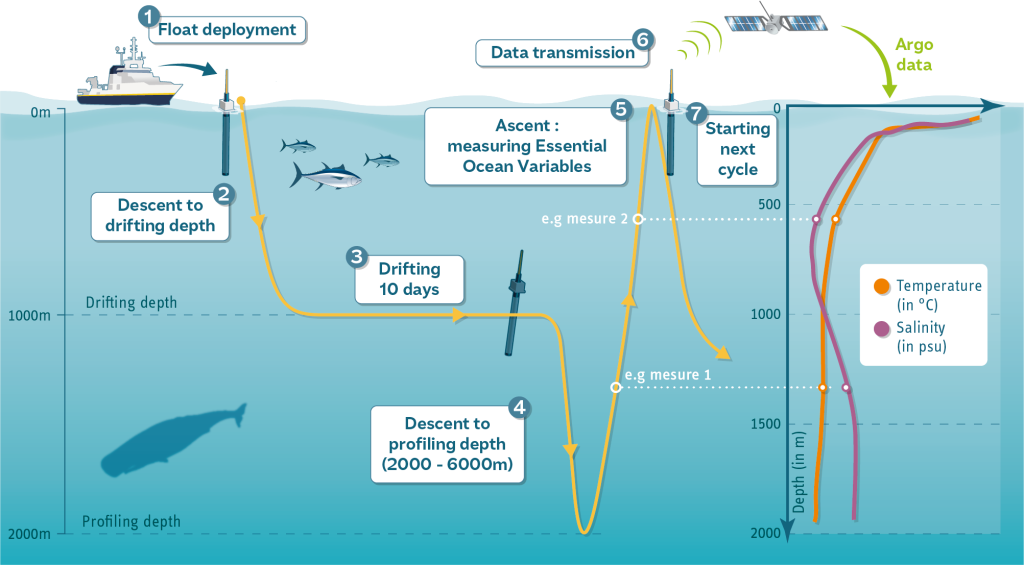
A standard Argo float typically operates on a 10-day cycle. Most of the cycle is spent drifting with deep ocean currents at a depth of around 1,000 metres. Near the end of the cycle, the float descends to its profile depth of approximately 2,000 metres and then slowly rises to the surface, collecting measurements of conductivity, temperature and pressure throughout its ascent. Once the float reaches the surface, it determines its position, typically using GPS, and communicates with a satellite to transmit the collected data and receive any new mission instructions. For most of the Argo fleet, the float remains at the surface for approximately 15 minutes to one hour before beginning the next cycle. After communication is complete, the float descends again to its drift depth of around 1,000 metres, where it remains for approximately nine days before repeating the profiling cycle. This cycle continues throughout the float's operational lifetime, which is typically around 4–5 years, although the actual lifetime varies depending on the float design, sensors, mission configuration and battery capacity.
What is inside the float?
Inside the float are several main systems:
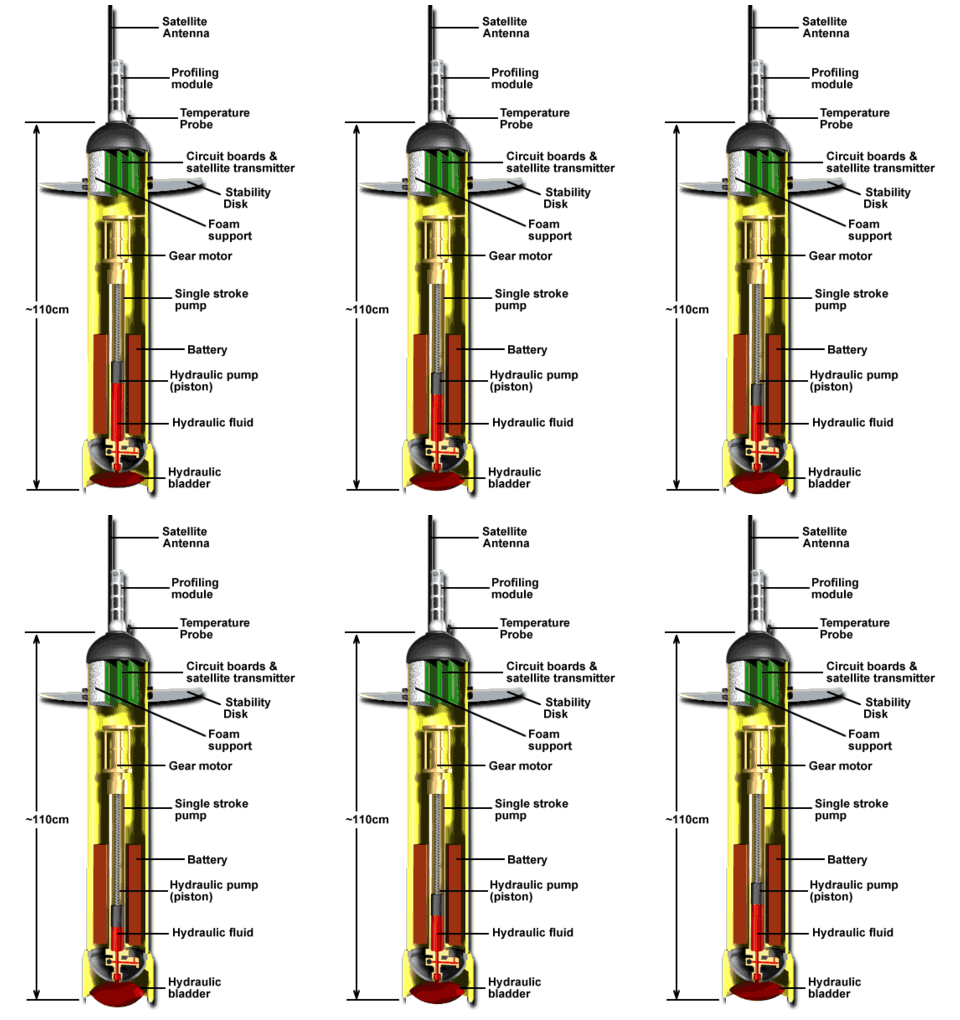
Antenna: The antenna is normally located at the top of the float. When the float reaches the surface, the antenna protrudes above the water, allowing communication with satellites.
Sensors: These are mounted at the upper part of the float and measure the properties of seawater as the float moves through the ocean. Depending on the float, this can include: Temperature, Salinity (measured using conductivity), Pressure, Dissolved oxygen, pH, Nitrate, Chlorophyll-a, Backscattering (used to study particles), Downwelling irradiance/light.
The typical float types in the UK Argo fleet are:
- Pressure: Druck, Kistler,
- Sality and Temperature: SBE41, SBE61, RBR
- Oxygen: SBE63, AANDERAA_OPTODE_3830, AANDERAA_OPTODE_4330, AANDERAA_OPTODE_4381
- Nitrate: SUNA_V2
- pH: SEAFET
- Chlorophyll-a: Wetlabs ECO FLBBCD
- Backscattering: WETLABS ECO_FLBBCD
- Irradiance: SATLANTIC_OCR504_ICSW
Controller/computer and data storage: At the heart of the float is an electronic controller that controls the mission. It determines when to start a profile, sink to the target depth, control and store measurements from sensors, stop sampling, communicate at the surface and transmit data, and begin the next cycle. Measurements are stored internally while the float is underwater. Once the float reaches the surface, the stored data are prepared for transmission.
Positioning and communication: When the float reaches the surface, it uses satellite communication to determine its position, transmit the collected measurements and receive new instructions if required. Modern floats commonly use satellite systems such as Iridium, although other communication systems have also been used.
Batteries: Large battery packs provide power for: sensors, pump and buoyancy system, internal computer, data storage, communications and positioning. Battery capacity is one of the important factors determining how long an autonomous float can operate. For core floats, it typically operates for around 4-5 years and for BGC floats it is around 3-4 years.
Buoyancy control system: This is what allows the float to move vertically through the ocean. A typical float has an oil-filled bladder. A pump moves oil between an internal reservoir and an external bladder:
- Oil pulled inside → the float becomes denser and sinks.
This allows the float to profile from the surface down to typically 2,000 m, with Deep Argo floats capable of reaching around 6,000 m.
Pressure-resistant electronics housing: The sensitive electronics, batteries and other components are protected inside pressure-resistant housings. This is essential because pressure increases enormously as the float descends to several thousand metres.
2.jpg)
3.jpg)