![UK Argo [logo]](/themes/ukargo-NOC8X/logo.svg)
Real - Time Argo Data
Argo real-time data consists of oceanographic measurements collected by a global array of over 4,300 autonomous operational robotic floats. Transmitted via satellite within 12 to 24 hours of collection, these data streams undergo rapid automated quality control to support operational weather forecasting, marine research, and climate monitoring.
All data being part of the Argo international programme are relayed and made publicly and freely available within hours after collection.

BODC DAC
The BODC DAC at NOC supports ocean science through the ingestion, processing and delivery of real-time and delayed-mode Argo data from all UK-operated floats, as well as floats from Ireland, Brazil and European floats.
The BODC Argo DAC plays an important role in providing high-quality, daily ocean observations that support continuous monitoring of the state of the ocean. These observations contribute to a better understanding of marine environmental change, helping scientists identify patterns and trends and improve predictions of future ocean conditions. They also provide essential evidence to inform policies and legislation aimed at protecting vulnerable marine environments and coastal areas.
BODC Argo processing system
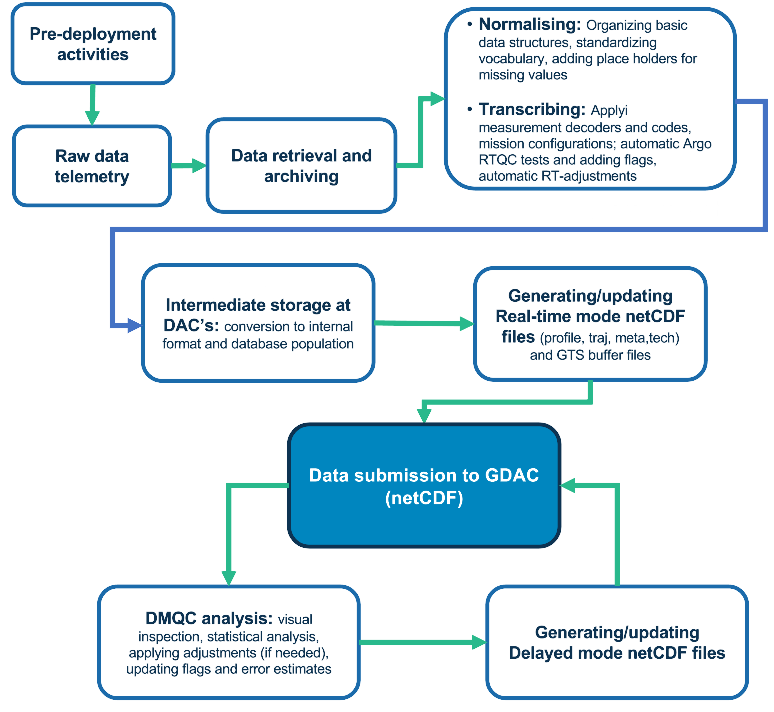
Data generated in real-time at BODC
- Core Argo parameters (up to 2000 m): Pressure, Temperature, Salinity, Trajectory data
- Biogeochemical (BGC) parameters: Pressure, Temperature, Salinity, Oxygen, pH, Fluorescence (Chlorophyll-a) and CDOM, Particle backscatter (BBP), Nitrate (NO3), Irradiance
- Deep Argo parameters (up to 6000 m): Pressure, Temperature, Salinity, Oxygen
- Pilot and experimental sensors: Turbulence microstructure profiler, Turbidity sensor, Underwater Vision Profiler (UVP)