![UK Argo [logo]](/themes/ukargo-NOC8X/logo.svg)
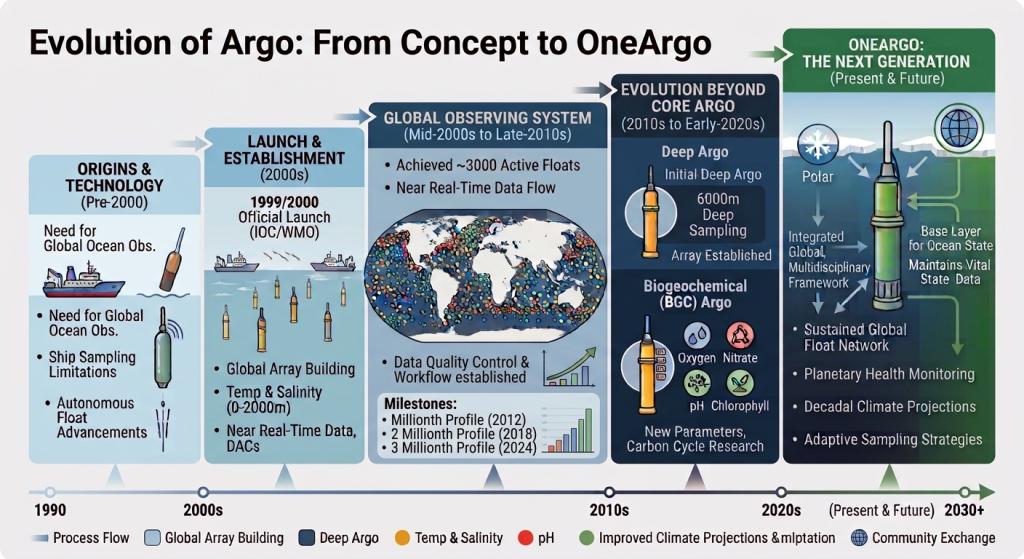
The idea behind Argo emerged from the growing need for sustained, global-scale ocean observations to better understand ocean circulation, climate variability, and long-term environmental change. Earlier programmes such as the World Ocean Circulation Experiment (WOCE) demonstrated the scientific value of ocean observations but also highlighted the limitations of ship-based sampling. Advances in autonomous float technology during the 1990s enabled the development of profiling floats capable of collecting temperature and salinity data across the global ocean with minimal human intervention.
Establishment of the Argo Programme
The international Argo Programme was officially launched in 1999/2000 by the IOC and WMO as an international partnership and global collaboration to build and maintain an array of autonomous profiling floats. The programme aimed to deliver near real-time temperature and salinity observations from the upper 2000 m of the ocean, to monitor the ocean's variability and understand its role in climate. Early efforts focused on float deployment, satellite communications, and establishment of international data management systems and Data Assembly Centres (DACs). Argo rapidly became one of the most important components of the global ocean observing system.
Expansion into a Global Ocean Observing System
By the mid-2000s, Argo achieved its target of approximately 3000 active profiling floats distributed across the global ocean. Continuous improvements in float technology, data transmission, quality control, and international coordination transformed Argo into an operational and research-critical observing network. In 2012, the programme reached a major milestone with delivery of the millionth Argo profile, highlighting the scale and global impact of the observing system. On 12 July 2024, Argo reached another landmark achievement with more than 3 million temperature and salinity profiles collected since the programme began in 1998. This represents approximately three times the total number of CTD profiles collected globally since the first use of CTD instruments at sea in 1960, demonstrating the transformative impact of Argo on global ocean observations. Argo data became essential for climate monitoring, weather prediction, ocean forecasting, and marine research. Delayed-mode quality control procedures and internationally standardised workflows significantly improved long-term data consistency and scientific reliability.
Evolution Beyond Core Argo
As scientific priorities evolved, Argo expanded beyond temperature and salinity observations. Deep Argo floats were developed to sample the abyssal ocean reaching 6000 m, while Biogeochemical (BGC) Argo introduced sensors measuring oxygen, nitrate, pH, chlorophyll, and other key parameters. These developments enabled Argo to support a broader range of applications, including carbon cycle research, ecosystem studies, and improved understanding of climate-driven ocean changes. At the same time, new software systems, QC approaches, and metadata standards were developed to support the increasing complexity of observations.
OneArgo: The Next Generation
OneArgo represents the future evolution of the Argo Programme into a fully integrated, global, multidisciplinary ocean observing system. It combines Core, Deep, BGC, and Polar Argo into a single coordinated framework designed to provide sustained observations from the surface to the deep ocean, including under sea ice regions. OneArgo aims to improve global coverage, strengthen operational sustainability, and support growing societal and scientific needs related to climate change, marine services, and ocean health. It revolutionises the ability to observe and predict the impact of climate change on oceanic heat uptake, the global water cycle and sea level rise, as well as ocean ecology, metabolism, carbon uptake, and marine resource modelling. Most importantly, it increases end-user value and the benefits for society at large, for instance through more accurate climate projections enabling better societal adaptation.
The programme also drives continued development of international collaboration, scalable data systems, and advanced quality control methodologies to support the next generation of ocean observations.