![UK Argo [logo]](/themes/ukargo-NOC8X/logo.svg)
UK Argo programme
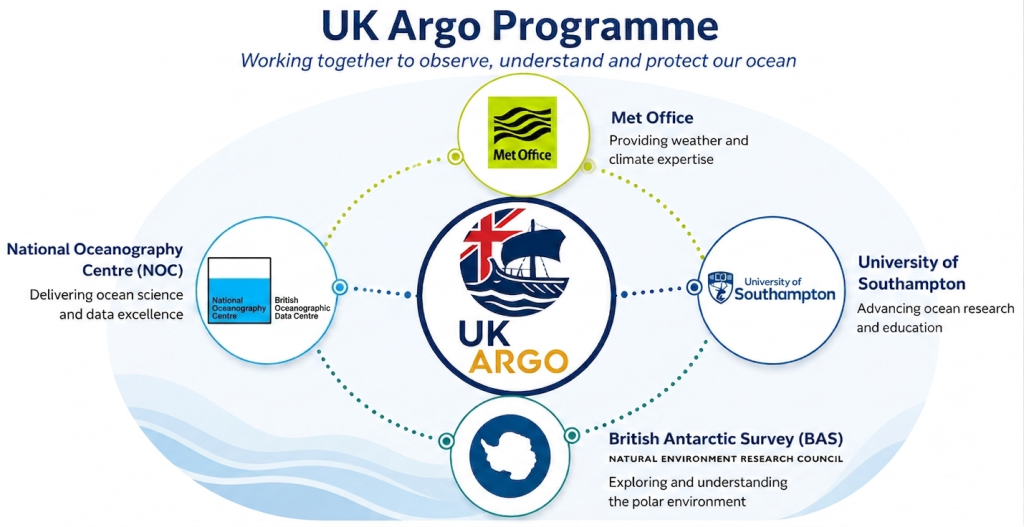
The programme is undertaken by a partnership between the Met Office, the National Oceanography Centre (NOC), which includes the British Oceanographic Data Centre (BODC), the University of Southampton (UoS), and the British Antarctic Survey (BAS).The UK programme was initiated in 2000, with our first Argo floats being deployed in January 2001.
Argo is a cornerstone of the UK’s contribution to the Global Ocean Observing System, providing essential observations for weather forecasting, climate monitoring and ocean prediction. This is particularly important for the UK because of the strong influence of the North Atlantic on UK weather and climate. Through the contributing partners, the UK also contributes world-leading expertise in float deployment, data management, quality control and ocean science. Strengthening UK Argo therefore supports both national climate and environmental priorities and the UK’s international leadership in ocean observing.
Key Factors Driving UK Argo Success
The success of the UK Argo Programme depends on effective collaboration between partner organisations, sustainable investment in people and infrastructure, and the continued delivery of high-quality data management and scientific services.
- Programme coordination: The Met Office leads programme management and coordination, including procurement of Argo floats, deployment logistics, float preparation, and satellite telecommunications. Effective programme governance, together with sustainable long-term funding, is fundamental to maintaining UK Argo operations.
- Scientific leadership and float operations: The National Oceanography Centre (NOC), British Antarctic Survey (BAS), and University of Southampton (UoS) are responsible for procuring and deploying UK and project-funded Argo floats, developing data management plans, and advancing Argo science. NOC leads the UK's Deep Argo programme and, together with UoS, plays a leading role in the expansion of Biogeochemical (BGC) Argo.
- Data management and operational delivery: As part of one of the ten Global Argo Data Assembly Centres (DACs), BODC delivers real-time processing and delayed-mode quality control data for all UK Core, Deep and BGC Argo floats. Maintaining timely processing, supporting new float technologies, reducing software technical debt, and implementing evolving Argo Data Management Team (ADMT) requirements are essential to sustaining an efficient operational service.
- International collaboration and innovation: BODC also support partner national programmes, contributes to European and global Argo governance, develops open-source software, and provides technical expertise through workshops, training, publications, and community support. Continued investment in staff development, software engineering, advanced quality-control methods, machine learning, and NERC Vocabulary Server (NVS) governance ensures the UK remains at the forefront of international Argo data management and maintains interoperability across the global observing system.
Strategy and Goal
To deliver a sustainable, innovative and internationally recognised UK Argo Programme that provides trusted ocean observations to advance science, support evidence-based decision-making and strengthen understanding of our changing ocean.
Strategic Goal | Why it Matters | |
|---|---|---|
| Deliver a Sustainable Ocean Observing System | Provides continuous ocean observations that are essential for understanding climate change and supporting UK marine capability. |
| Provide Trusted Ocean Data | Enables governments, researchers and industry to make informed decisions about climate, weather and the marine environment. |
| Drive Innovation | Ensures the UK remains at the forefront of ocean observing while delivering better value for public investment. |
| Strengthen International Leadership | Maximises the UK's influence, scientific impact and access to international expertise. |
| Maximise Societal Impact | Ensures UK Argo delivers tangible benefits to society, the economy and future generations. |



UK Argo Stakeholders
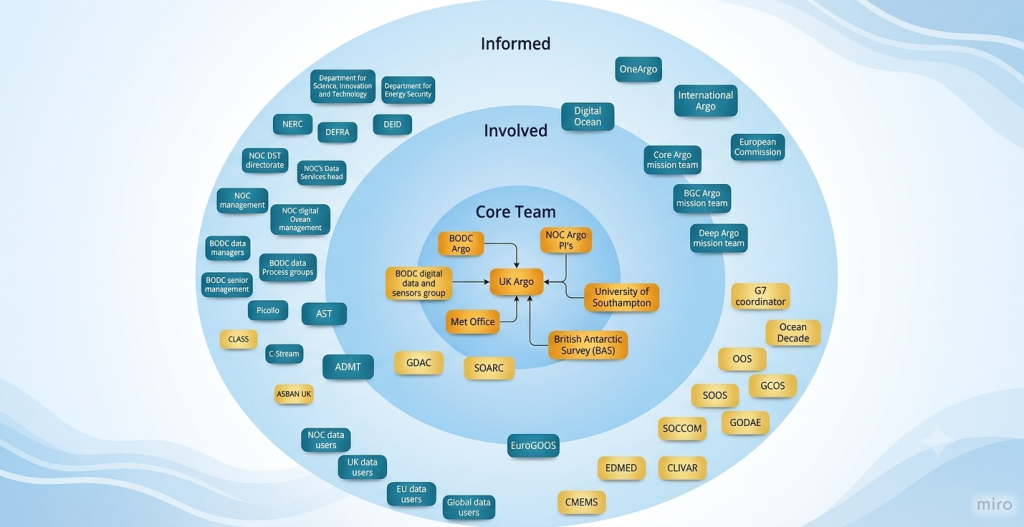
The core UK Argo team consists of three closely collaborating organisations responsible for the delivery of the UK Argo Programme. They are supported by a wider network of stakeholders who contribute expertise, infrastructure, governance and strategic direction.
Key delivery partners include the Euro-Argo ERIC Management Board, GDAC, GTS, and NZOC, which provide programme oversight, data dissemination, international coordination and support the long-term development of ocean observing capability.
The BODC Digital Data and Sensor Group, NOC IT, and Euro-Argo projects and working groups form a critical bridge between programme delivery and the wider Argo community. They support operational infrastructure, software development, training, and collaboration on real-time and delayed-mode data management.
Strategic stakeholders include funding organisations such as NERC, NOC programmes, and the European Commission, together with OneArgo and the International Argo Programme, which shape the future direction and priorities of the global observing system. Equally important are the UK, European and international user communities, whose scientific and operational needs drive continual improvements to the programme.
The Argo Steering Team (AST) and Argo Data Management Team (ADMT) provide international governance, coordinating technical developments, operational practices and data management standards to ensure consistency across all national Argo Data Assembly Centres.